Great Falls MT
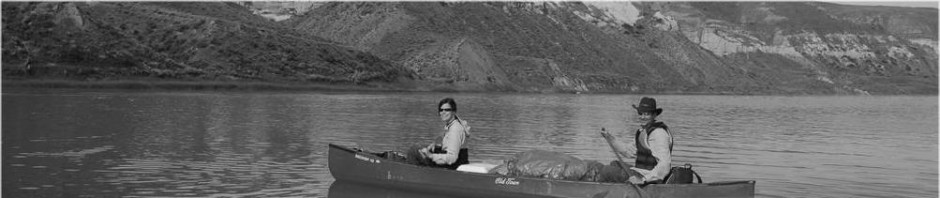
Had our first good peek at the Upper Missouri River today. This means we’re getting real close to Ft Benton a little ways further down river where we will be dropping our canoe in and floating away for a few days.. Meanwhile, one more little stopover here in Great Falls to have a look at the highly regarded Lewis and Clark Interpretive Center (fancy word for museum, evidently) and perhaps the waterfalls themselves if we can find them.
 Our stay here in Great Falls began last night at the Perkins Motel. A shopping excursion led us to see a beautiful sky of sculptured clouds, pink and yellow setting sun and a double rainbow. Later, a drink at That Bar (t-shirts for sale saying: “alcoholism is a disease: get your shots at That Bar”) – lots of smoke, bad Karaoke, mullets and missing teeth. Editor’s note: if you were to want to try your hand at it, Great Falls is the place to try Karaoke, as the scene is about 10 years behind Seattle, where everyone’s a pro.
Missouri River outside of Great Falls. To right of river is the trail leading to the L&C Museum.
This morning we took a wonderful walk along a path above the Missouri river. The path from town to the museum is part of the increasingly popular rails-to-trails movement, which has seen many abandoned freight railroad tracks ripped out and replaced with pavement or gravel. With their nice smooth even grades and prime waterfront views, these formerly under-utilized rail lines make ideal walking and biking trails. The distance along the path from town to the museum is about 4 miles each way. Just about the perfect distance for a nice stroll…
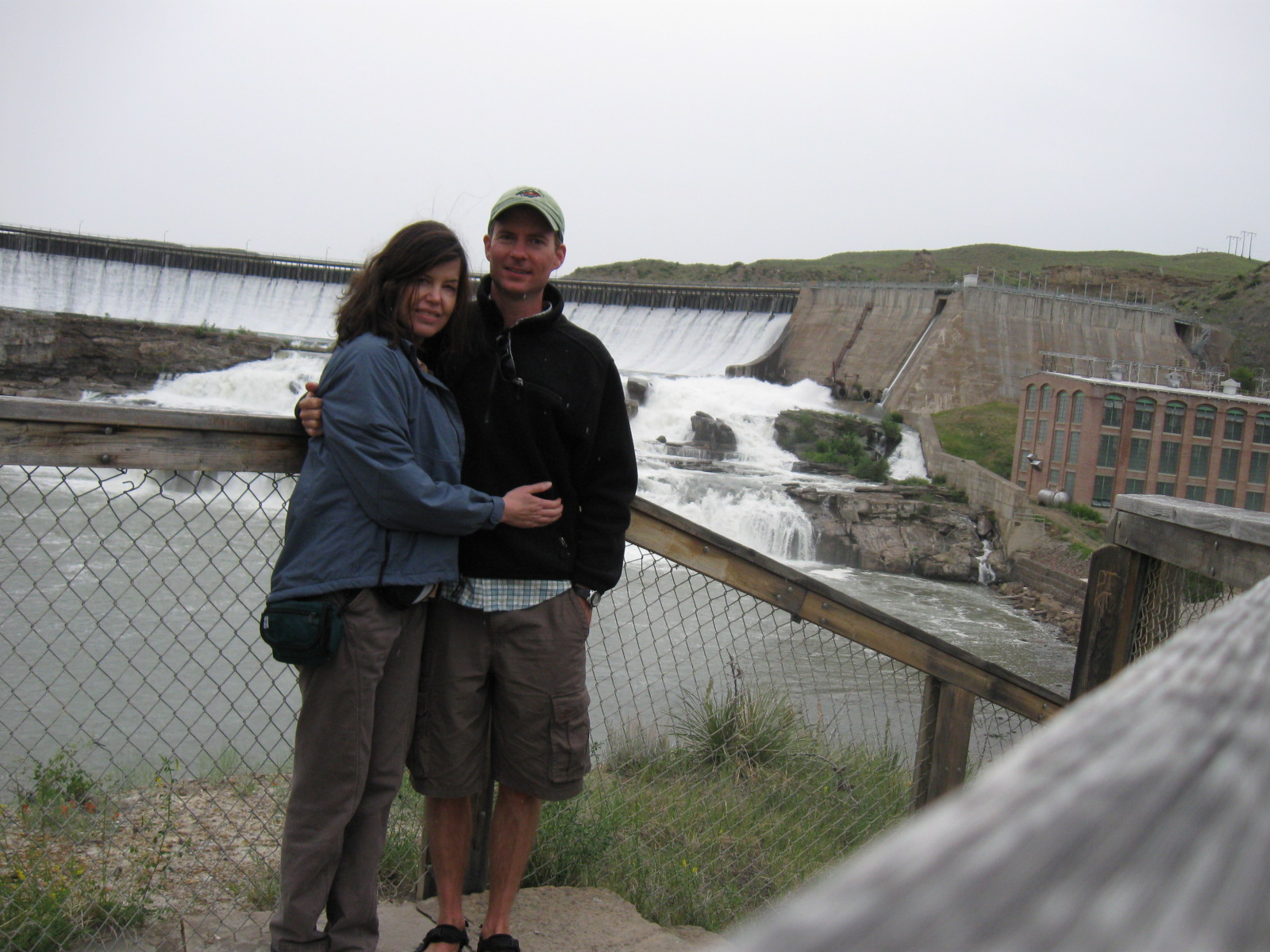
 Along the way we stopped at an overlook to check out a little dam and waterfall called Eagle Falls. We were initially wondering if this was in fact the Great Falls waterfall. But much to our collective relief we would soon learn the bigger falls are further down-river.
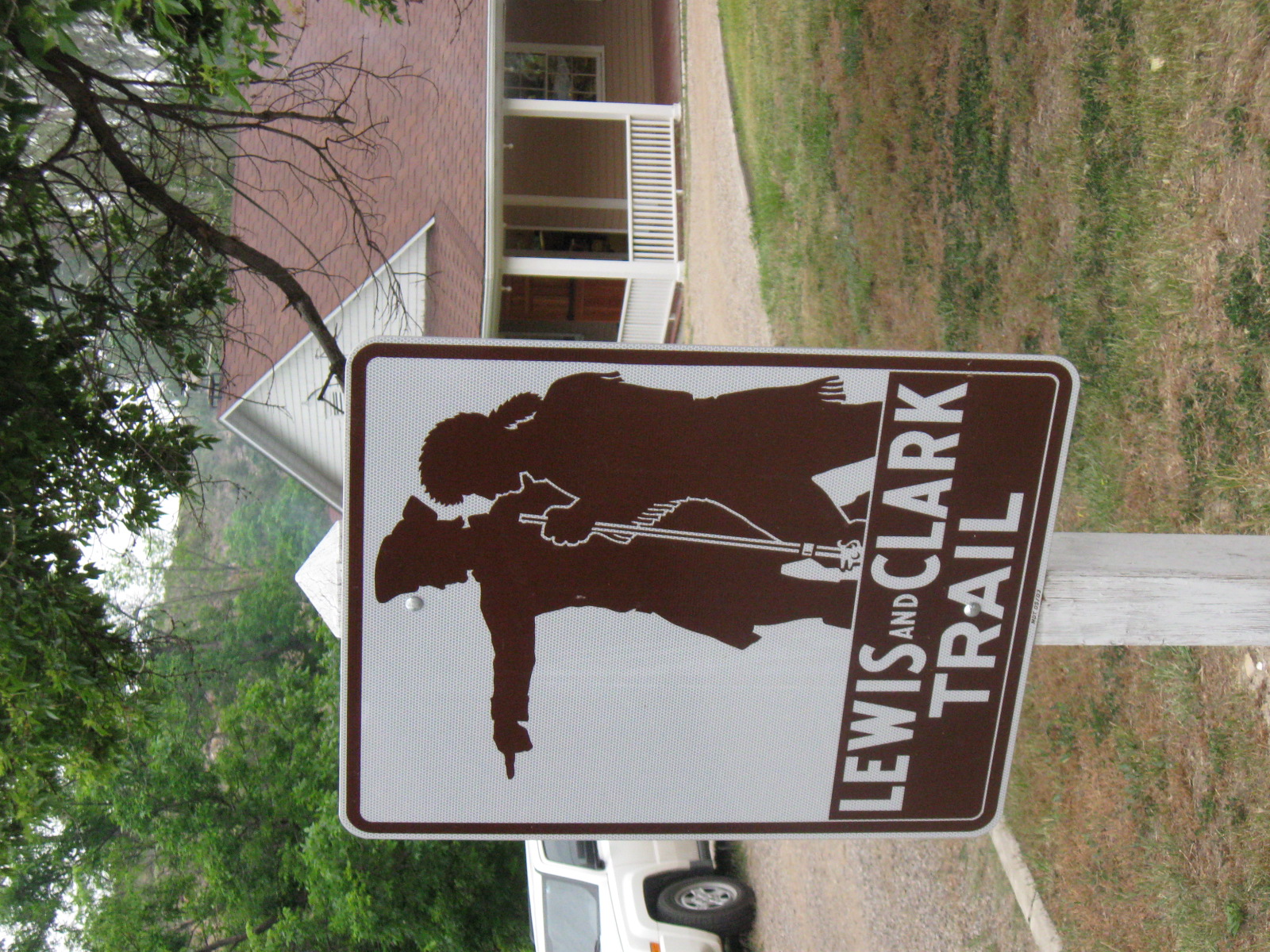
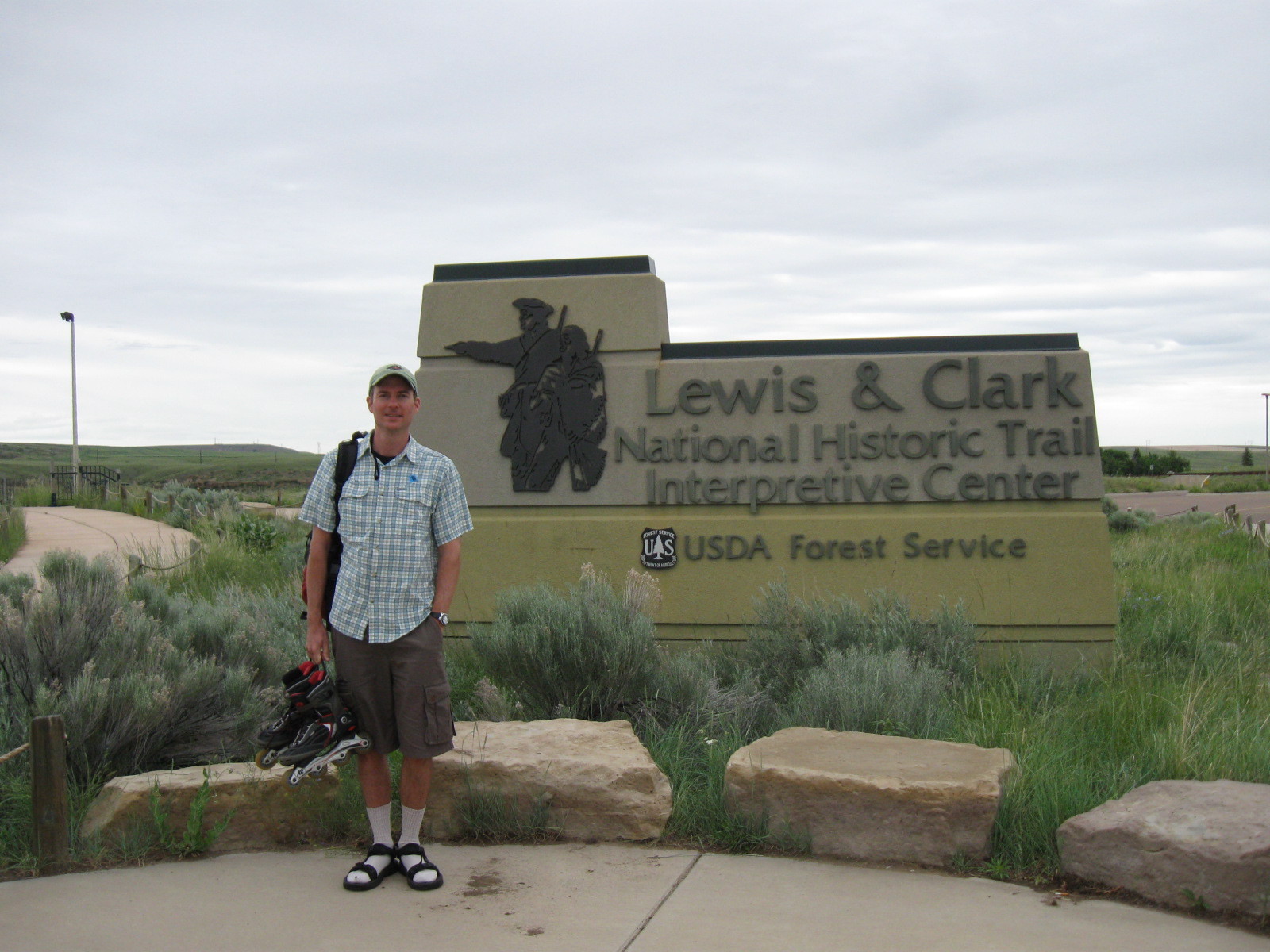
In a little over an hour we arrived at the museum with the record for the longest name: The Lewis & Clark National Historic Trail Interpetive Center! With extensive information and exhibits profiling the journey of the Corps of Discovery, the center is not to be missed for any L&C enthusiast, nor upper Missouri River canoe or kayak paddler for that matter.
Inside the museum we were immediately greeted by a Parks Service Ranger presiding over an assortment of L&C era weapons. The exhibit featured several flint-lock rifles as well as powder horns and lead balls. As we were perusing it, the Parks Service employee asked us if we wanted a demonstration. As Rob looked around to see if there were any musket ball holes in the walls, the ranger reassured us that he just meant the flint mechanism part, which produced some impressive sparks.
What really caught our attention however was a sculptured re-enactment of an enormous canoe being hoisted up a steep hill on a push cart, which we realized was the Corps of Discovery portaging the Great Falls. What Lewis and Clark assumed would be a one day portage turned into a treacherous and slow-going ordeal. Just when they had gotten around one large waterfall, another would be looming just up-river! And then another.. In fact it was fully one month after sizing up the waterfall before the corps had safely portaged all their men, boats and supplies around all five waterfalls cumulatively known as the Great Falls of the Missouri, and were again safely in navigable waters.
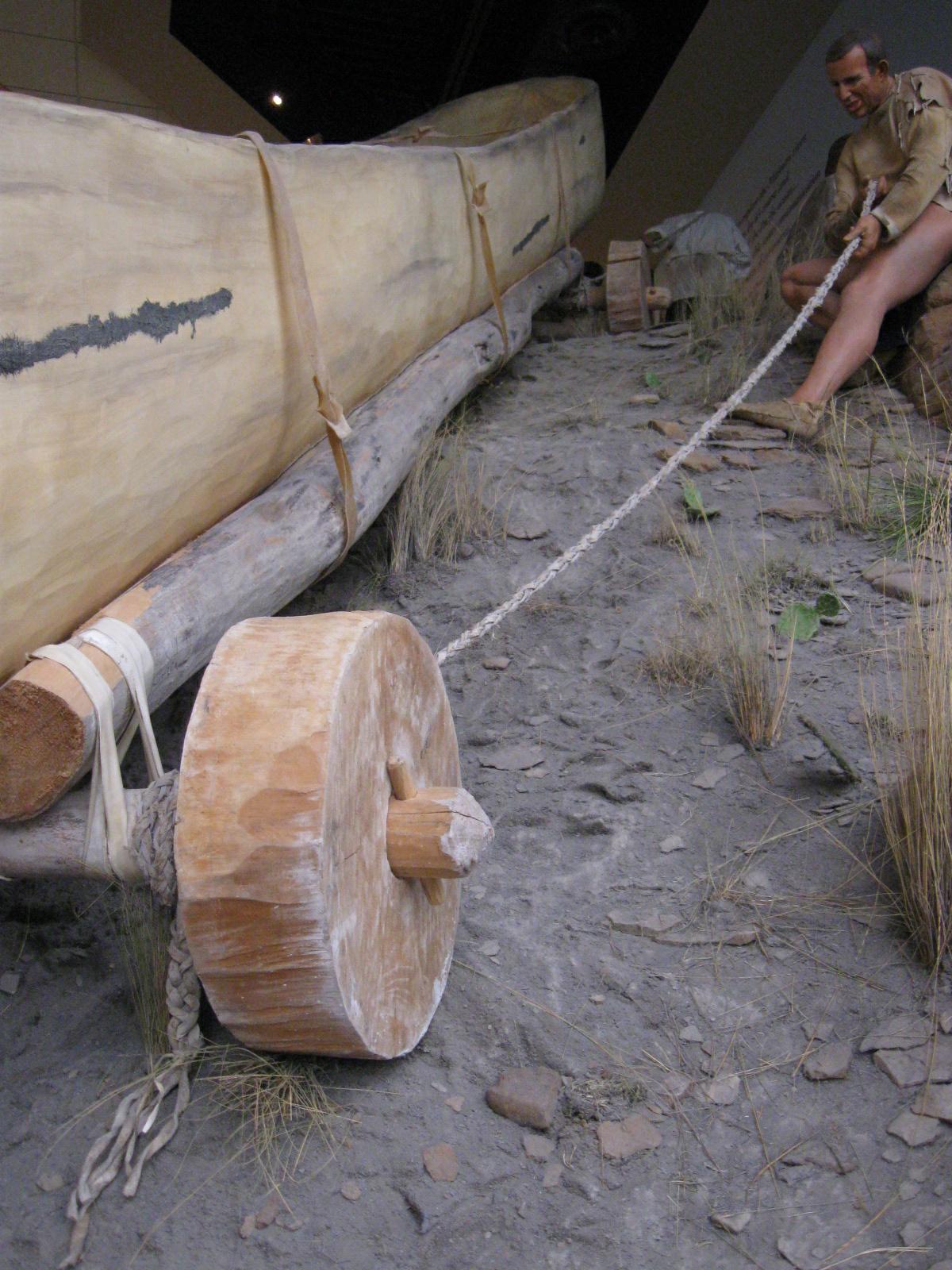
"The Corps would have to hike 18 miles to get around the five waterfalls. They left their heaviest boat and equipment hidden near the base of the falls. The other canoes and supplies were carried, dragged, and pushed."
These ingenious makeshift wagons may have been the very first water-craft roof rack systems ever devised, and from our present-day perspective they looked very much like our big canoe strapped up there on the roof of the Behemoth. It is clear the challenges Lewis and Clark faced going upstream in this section of the river were substantial. For our part, going down-stream I think its safe to say we are going to have an easier time then they did. (umm.. we just hope all those waterfalls are safely above us when we set out from Ft Benton- perhaps as early as tomorrow morning..)
While at the L&C Interpretive Center, we begain to realize ironically that one of the little mysteries about the falls that had us scratching our heads for much of the day today also had stumped Lewis and Clark some 200 years prior. The mystery was cleared up for us as we started learning about the ordeal those guys faced in portaging all of the falls. As it happens, Great Falls the waterfall (the tallest of the 5 falls of which in aggregate bear the same name) is not in Great Falls the town.
Today, in order to see this most singularly impressive of the 5 falls, one has to drive half way to Fort Benton 20 miles out of town, and then on a 10 mile detour from the highway. When we read that Lewis described this waterfall as ” the grandest sight I have ever beheld”, right then and there we decided we should pay tribute to their great portage and go have a look at this historic natural landmark. So after strolling back down the trail towards town and then packing up and checking out of our hotel, it was on to see the (supposedly greatest of the) Great Falls!
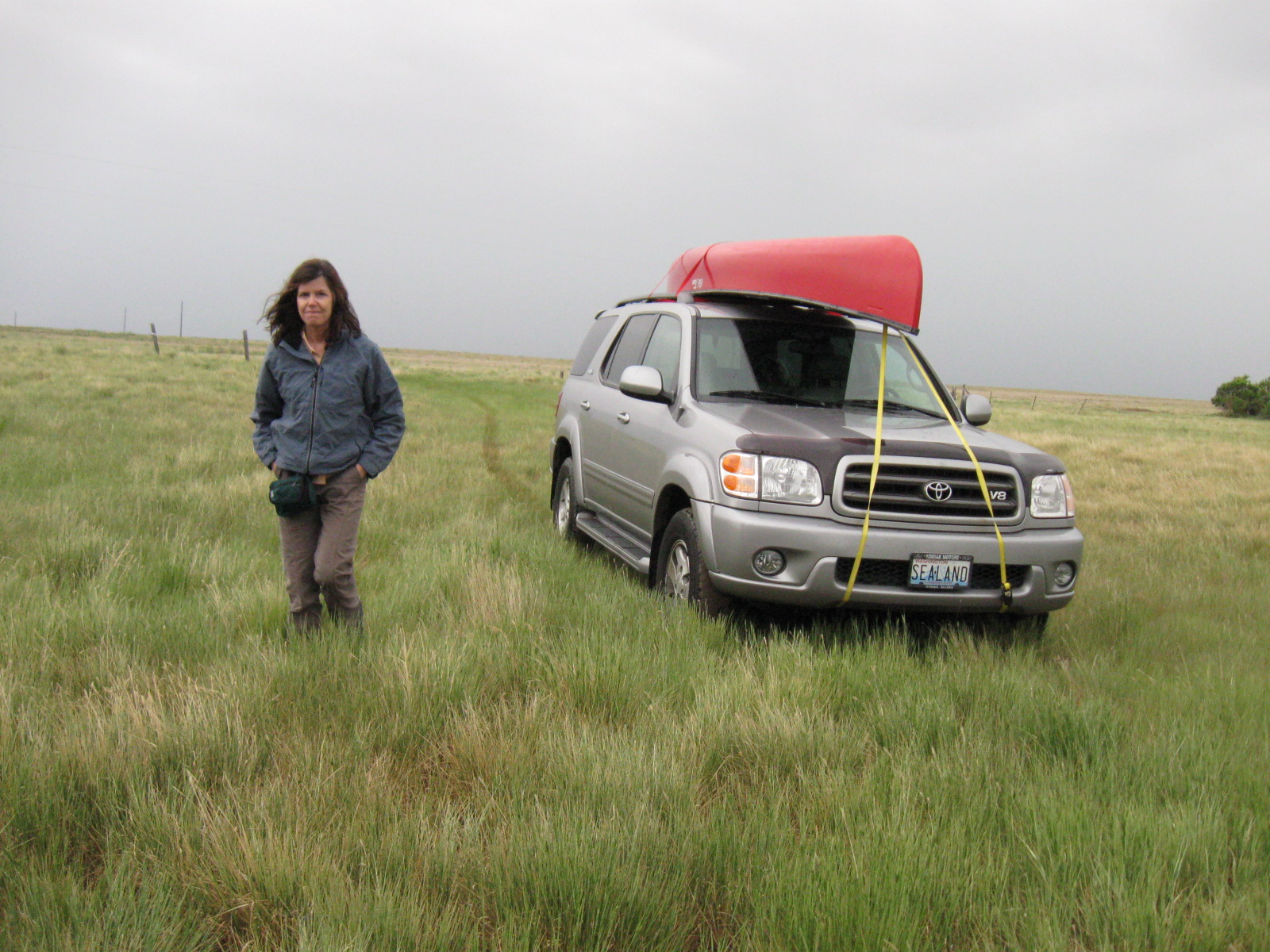
This looks like some place a tornado might touch down!
Heading out of town towards the falls, a drive along young wheat fields brought us to one of our potential accommodations for the night – an old, abandoned barn. This was another instance in our running joke about finding cheap accommodations! We decided to detour from our detour, and pulled off the highway as we bounced and rolled up a narrow path to this abandoned and dilapidated barn, we could not help but think we were witnessing a microcosm of the state of the family farm in America. Walking inside through the long since collapsed barn door, several birds and perhaps a bat or two swooped down from the rafters and whizzed by our heads on the way out. But then we also had visions of farmer John chasing after us with a shot gun, so we quickly high-tailed it out of there.
 As we approached the Falls (no more sidetracks), we began to make out the outline of the river gorge below. Although we could not yet detect any visual signs of a waterfall- such as the trademark billowing steam of Niagara Falls- we could hear the rush of white water and so we knew we were getting close.
Flash back again 200 years, and the sight of the falls was so magnificent it caused Clark (or was it Lewis? I always mix those guys up!) to also lament his oversight in neglecting to commission an artist for the voyage to capture the splendor of this vast land, and especially this powerful waterfall.
And again here in the future, as we rounded a corner we were promptly rewarded with a panoramic view of the Great Falls of the Missouri. They did not disappoint. We just had to imagine these falls as nature manufactured them. In other words without a big dam directly behind them. And also with the full volume of the river flowing over the falls- rather than the majority of the water being diverted into a channel flowing to a hydro-electric power plant! Oh well. Quite impressive nevertheless…
Then, in another instance of history repeating itself, we had walked all the way from the parking lot to a little scenic overlook above the falls before realizing we forgot the camera!